

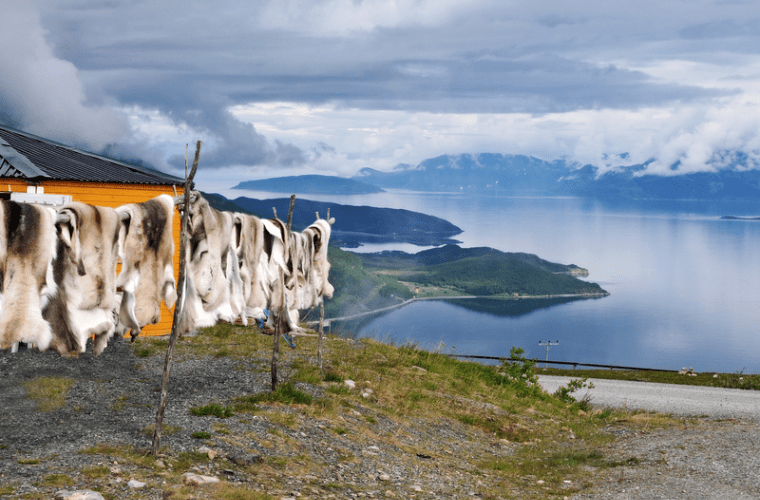
When most people think of animal products, “eco-friendly” and “ethical” aren’t usually the first words that come to mind. So why are reindeer hide rugs considered to be both?
The answer comes down to two things most other rug materials simply can’t claim: genuine reindeer pelts directly support some of the world’s most at-risk indigenous communities, and they’re one of the strongest natural products on the market when it comes to reducing waste. In this article, I’ll focus on both — and how they make a reindeer skin rug one of the more environmentally and ethically considered floor coverings you can bring into your home.
If you’ve already read our piece on whether reindeer rugs are ethical, this article picks up where that one left off — looking specifically at the environmental and community impact rather than the farming and welfare side.
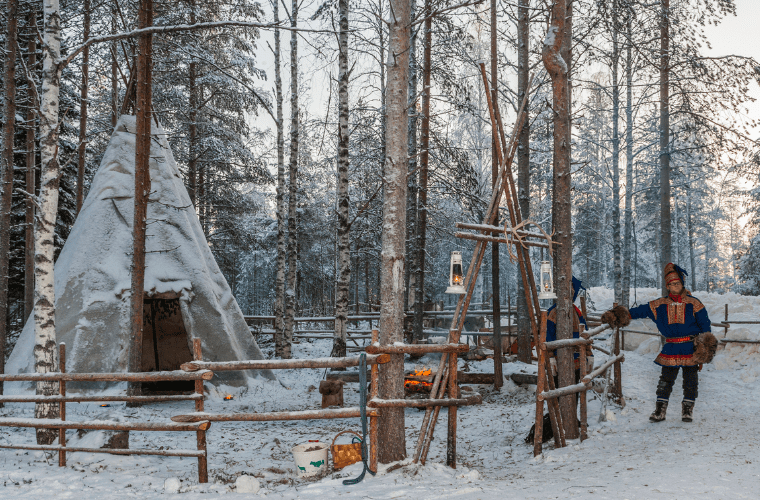
How Reindeer Pelts Support Indigenous Sámi Communities
One of the strongest ethical arguments for choosing a reindeer hide rug is something that often gets overlooked: every genuine pelt directly supports the livelihoods of indigenous Arctic communities, particularly the Sámi people of northern Scandinavia.
The Sámi are Europe’s only recognised indigenous people, with traditional territories spanning northern Norway, Sweden, Finland, and parts of Russia. For thousands of years, reindeer husbandry has been at the heart of Sámi culture — economically, socially, and spiritually. In Finland, reindeer herding is so culturally significant that it’s legally protected as an industry reserved primarily for Sámi communities.
As The Polar Connection — a polar research and policy initiative — puts it: “many of the northern cultures would not exist without reindeer and caribou: they have provided food, warmth, and materials for generations, and are still a significant source of income and central to their spiritual lives.”
What this means in practice is that when you buy a genuine reindeer skin rug from a responsible supplier:
- You’re supporting traditional herding livelihoods in some of the world’s most remote and economically fragile regions
- You’re helping sustain a cultural practice that has existed for millennia
- You’re contributing to an economy where, in places like northern Finland, reindeer husbandry is one of very few viable forms of employment
- You’re helping ensure that traditional Sámi knowledge of the land, the seasons, and the herds continues to have economic value
It’s a rare thing in modern retail — a product whose purchase genuinely strengthens a culture rather than diluting one.
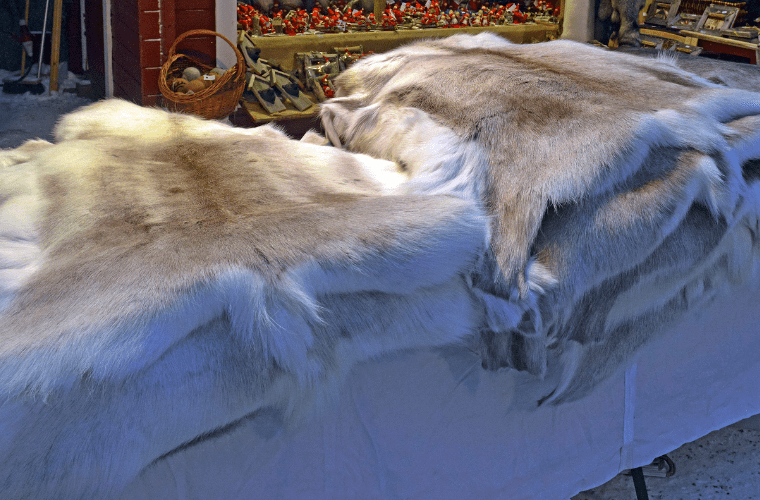
Reindeer Skin Rugs and the Move Towards Zero Waste
The eco-friendly case for reindeer hide rugs comes down to a single, powerful principle: using what already exists.
Reindeer are farmed for meat across the Nordic countries, and the hide is a natural by-product of that food industry. Without a market for the pelts, they’d be discarded — a durable, naturally insulating, biodegradable material thrown away simply because there was nowhere for it to go. Transforming those hides into long-lasting rugs is exactly the kind of circular thinking that genuinely sustainable design demands.
From an environmental perspective, a reindeer hide stacks up remarkably well against the alternatives:
- Biodegradable at end of life — a natural reindeer pelt will eventually return to the earth, unlike synthetic rugs which can take hundreds of years to break down
- No petrochemicals involved — synthetic rugs are made from oil-based plastics, while a natural hide is, well, natural
- No microplastic shedding — synthetic carpets and rugs are now recognised as a significant source of household microplastic pollution; natural hides shed only organic fibres
- Exceptional longevity — a well-cared-for hide easily lasts 10 to 15 years, often longer, reducing replacement cycles
- Low-impact production — modern hide tanning has dramatically reduced its environmental footprint compared to decades past
- Repurposes existing material — nothing has to be grown, manufactured, or extracted specifically to make the rug
That last point is the heart of it. When you buy a reindeer fur rug, you’re not adding to global demand for new materials — you’re putting an existing material to good use. It’s the same logic that drives the second-hand furniture movement, just applied to natural materials at the source.
Reindeer Hides vs Other Natural Floor Coverings: An Environmental Comparison
To put the eco-friendly case for reindeer skin rugs in proper context, it helps to compare them directly against the main alternatives on the market:
Synthetic rugs (polypropylene, nylon, polyester): Made from petroleum, energy-intensive to produce, shed microplastics throughout their lifespan, and take centuries to break down in landfill. Cheap to buy but environmentally expensive.
Mass-produced wool rugs: Natural, but often come from long, untraceable global supply chains. Production can be water and energy intensive, and dyeing processes often involve significant chemical use.
Cotton rugs: Natural, but cotton is one of the most water-intensive crops on earth, and conventional cotton farming uses substantial pesticides.
Jute and sisal rugs: Among the more eco-friendly options — fast-growing natural fibres, biodegradable. Good environmental credentials, though less durable than hides over the long term.
Reindeer hide rugs: A by-product material that would otherwise be waste, biodegradable, traceable to source, and long-lasting. Genuinely repurposes existing resources rather than creating new demand.
No rug is perfectly impact-free, but among the realistic options for a natural, characterful floor covering, reindeer pelts hold their ground remarkably well.
Spotting a Genuine, Responsibly Sourced Reindeer Pelt
One of the loveliest things about a real reindeer fur rug is that its authenticity often shows itself in small imperfections — and these are nothing to be put off by. They’re proof of provenance.
When you buy a real, ethically sourced reindeer hide, you may notice:
- Small natural marks, scars, or pinholes from the animal’s life on open pasture
- Slightly uneven tufts of fur or natural density variations
- Distinct colour patterns and dorsal stripes unique to that individual animal
- Subtle differences in shape, since no two pelts are ever identical
These are all hallmarks of an animal that lived a real, free-roaming life. Mass-produced or synthetic alternatives are uniform precisely because they’ve never been alive — and that’s exactly what makes them feel lifeless underfoot, too.
A Considered, Conscious Choice
Reindeer rugs occupy an unusual position in the homeware world. They’re undeniably luxurious — the softness, the warmth, the visual character is unmatched — but unlike many luxury products, the more you understand about how they’re made and where they come from, the better the ethical and environmental case actually becomes.
They support indigenous communities. They use a material that would otherwise be discarded. They last for years. They biodegrade naturally. And they carry the genuine character of an animal that lived a real life in one of the most extraordinary landscapes on earth.
If you’d like to explore the collection, you can browse our full range of ethically sourced reindeer hide rugs — every hide individually photographed so you can see the markings and tones of the one you’ll be welcoming home. For more on sizing, sourcing, and choosing the right pelt, our reindeer rugs FAQ page covers the most common questions.